
Why Friendships Change as We Get Older
Last night, I listened to Mel Robbins talk about friendship in her book The Let Them Theory and honestly, it stopped me in my tracks.
It was one of those “how did I not know this sooner?” moments.
Maybe you’re reading this thinking, well… that’s obvious. If so, genuinely – good. I hope it’s saved you from some heartache, or at least a few hours of wondering why certain friendships seem to drift while others stay strong.
But for me, something really clicked.
Because friendships do get harder as we get older.
There’s research from a US university suggesting it takes around 200 hours to build a meaningful friendship. And when you think about it, that makes perfect sense.
When you’re younger, those hours just… happen.
You’re in the same classes, you share lunch breaks, you join the same clubs, sit on the same bus, go out to the same places. Time stacks up without you even trying.
But as an adult?
You’re working full-time. You might be in a relationship, raising a family, juggling responsibilities, living in different areas, managing completely different routines.
Those 200 hours suddenly feel almost impossible to reach.
And yes, this is often why we become close to people we work with.
But then another question appears:
Why don’t we become friends with all our colleagues?
And perhaps more interestingly…
Why do so many work friendships fade the moment one of you leaves?
For a long time, I didn’t understand that. Especially because I’ve always been someone who really means to stay in touch.
But listening to Mel Robbins explain adult friendships, something shifted in how I understood it all.
Friendships aren’t just about connection, they’re shaped by three key factors:
Proximity. Timing. Energy.
Proximity is the obvious one. How physically close you are. Do you see each other regularly? Do your lives naturally overlap? When that disappears, maintaining the same level of connection takes real effort.
Timing is subtler. It’s about where you are in life. You can like someone, even love them — but if you’re in completely different seasons, it can be hard to meet in the same space. One of you might be building a career, another raising children, another starting over.
And then there’s energy.
This is the one I felt most deeply.
Because energy shifts. People change. Life happens. Things are said, things go unsaid, priorities evolve and sometimes, even without a clear reason, the dynamic just isn’t the same anymore.
I saw all of this play out in my own life.
In my late 30s, I found myself part of an incredible group of women. There were seven of us, all within a few years of each other in age, and it felt like something I hadn’t experienced since my late teens.
We met at the gym and from there, life unfolded together.
Coffee dates, nights out, house parties, trips away, long chats, deep laughs, difficult moments. It was joyful, messy, real. The kind of friendship that feels like home.
And then, slowly, things began to change.
There were small fallouts. Then came COVID. Life moved on. People changed jobs, routines shifted, relationships evolved. Some of us stayed closer than others, but the group as it once was didn’t come back together again, no matter how much we tried.
For a long time, I couldn’t understand why.
We made attempts, more than once, to bring it back, in different ways. But something had shifted, and it never quite reformed as a group again.
Now I understand.
Our proximity changed – we weren’t all in the same place anymore.
Our timing changed – our lives moved in different directions.
And our energy changed – both because of what happened, and simply because we grew as individuals.
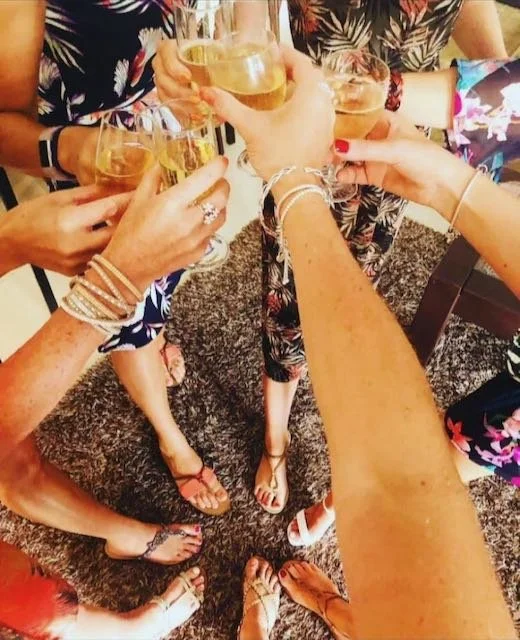
What I didn’t fully see at the time is that although the group as a whole changed, not everything was lost. Some of those friendships found a different shape, quieter, more individual, but still meaningful in their own way. And in many ways, those connections have continued to grow, just not in the way I once expected.
I’ve also noticed something about myself as I’ve got older. While I’ve loved being part of a group, I often find I value one-to-one time more deeply. Group settings can be fun, but they don’t always offer the space for the kind of connection I’m drawn to – the honest conversations, the moments where you can really open up and feel seen. And maybe that’s part of it too… not just that friendships change, but that we do.
And there’s something quietly comforting in that.
Because it doesn’t take away from what we had.
Not even slightly.
I wouldn’t trade those years for anything. The laughter, the connection, the shared experiences – they were real, and they mattered.
As Elizabeth Gilbert once said:
“People come into your life for a reason, a season, or a lifetime.”
And maybe that’s what I’m learning now.
Friendships don’t always last forever in the way we expect them to. But that doesn’t make them failures.
Some are here for a chapter.
Some evolve.
Some gently fall away.
And all of them, in their own way, shape us.
So now, I try to hold my friendships a little differently.
To appreciate the ones I have as they are.
To care for them while they’re here.
And, when the time comes… to let them go with gratitude rather than resistance.
Because making space is often what allows something new to enter.
If this resonates, you might like to sit with a few of these…
A few questions to reflect on
Which friendships in your life feel easy and energising right now and which feel harder to hold onto?
Have you ever held on to a friendship longer than it felt natural, and if so, what made it difficult to let go?
Looking back, can you see how proximity, timing, or energy have shaped your friendships over the years?
What would it feel like to appreciate your friendships as they are today, without needing them to stay the same or to be what they once were?
If this speaks to you and you feel ready to explore your own relationships, patterns, or what’s changing in your life right now, I’d love to support you through coaching.